
Bac de français — première générale et technologique
Réussir le bac de français, sereinement, avec un professeur qui connaît l’épreuve de l’intérieur.
Je suis docteure en littérature française, jury à l’oral du bac et correctrice des copies de l’écrit. J’accompagne moi-même chaque élève, du premier bilan jusqu’au jour de l’épreuve.
30 minutes, sans engagementRéponse sous 24 heuresFrance et international
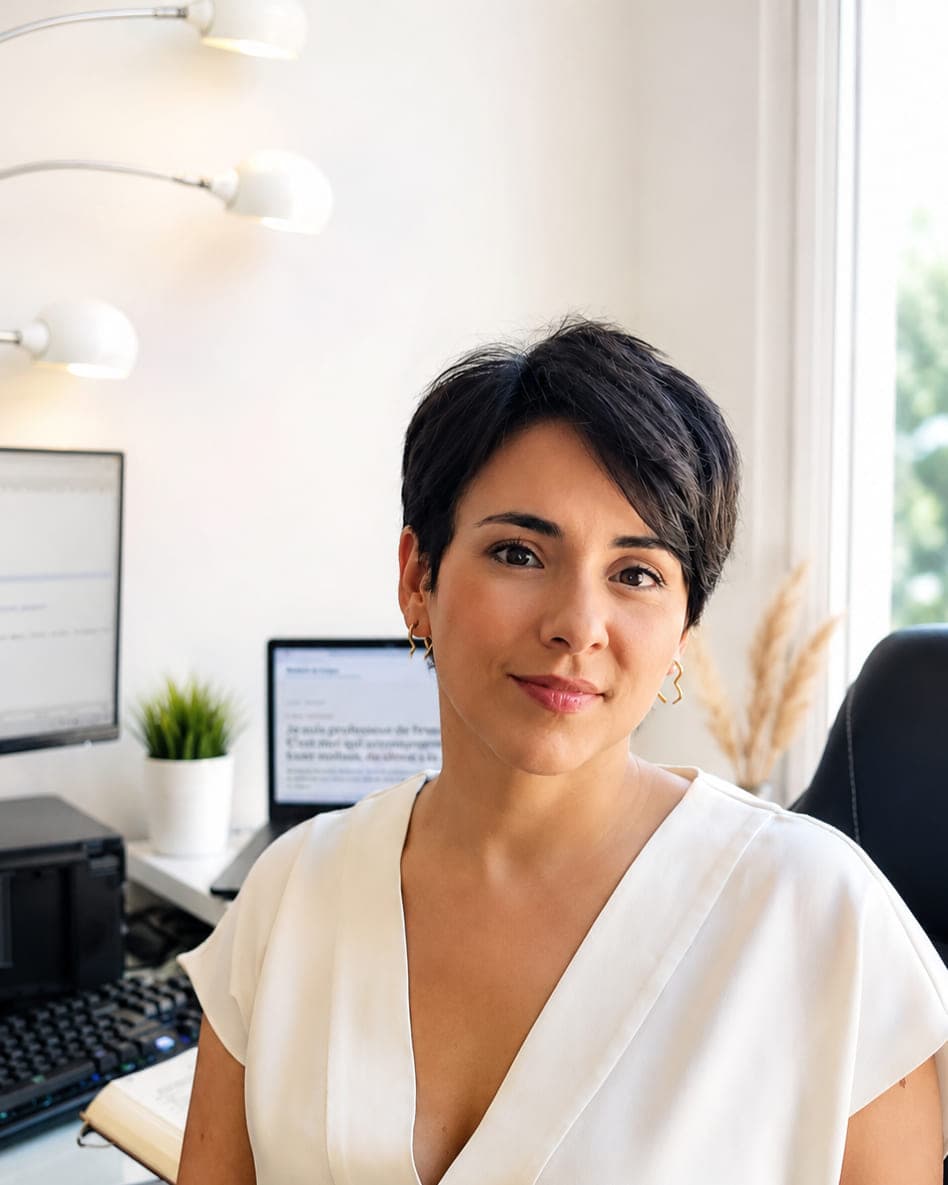
De l’autre côté du bureau
Jury à l’oral, correctrice à l’écrit
14 ans d’enseignement, et la connaissance exacte de ce qui est attendu le jour J.
Doctorate
in French literature
A level of specialisation rarely found in private tuition
14
years of teaching
From secondary school to university
+100
students taught
In France and internationally
Examiner
for the oral bac de français
And marker of the written papers
Ce qui change tout
Votre enfant n’a pas besoin d’une plateforme. Il a besoin d’un professeur.
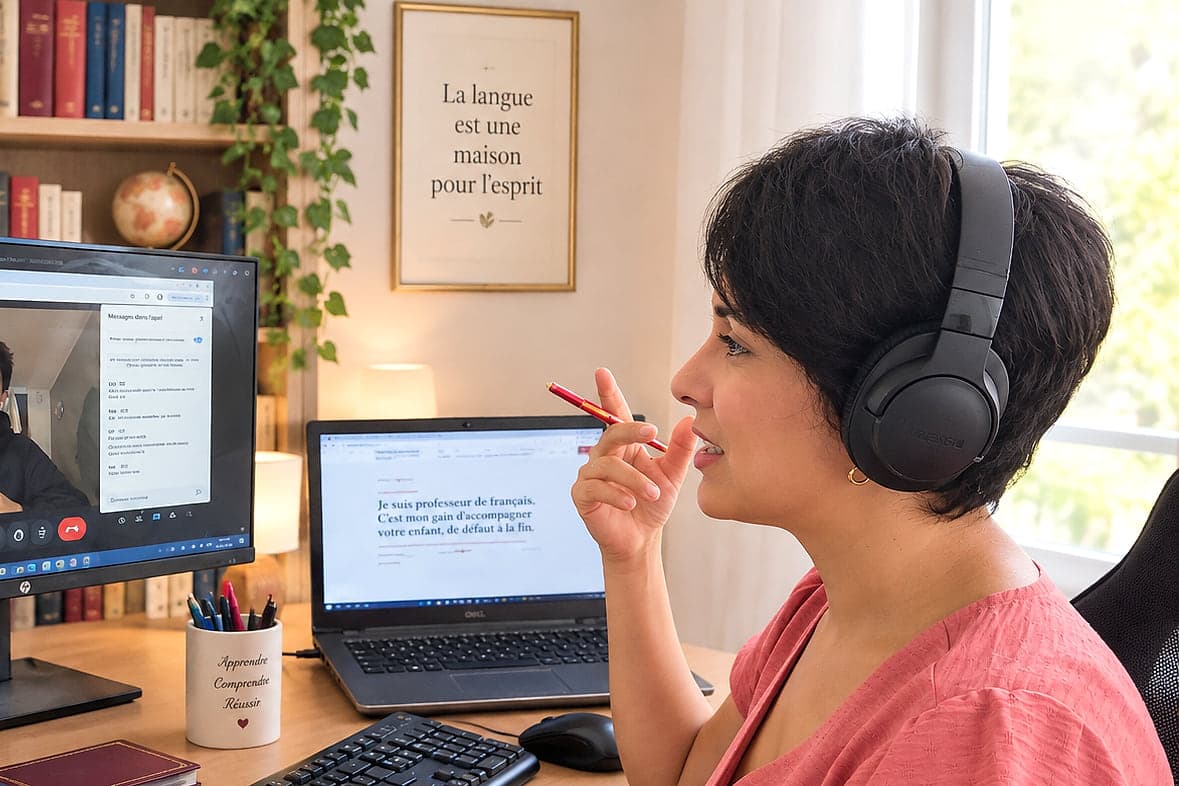
Je suis votre professeur, pas une plateforme ni une agence. Quand vous me contactez, c’est moi qui prends personnellement en charge l’accompagnement de votre enfant, du premier bilan jusqu’à l’épreuve.
Je limite volontairement le nombre d’élèves que j’accompagne chaque année. C’est la condition pour que ce suivi reste réel, et non une promesse commerciale.
Une plateforme ou une agence
- Un intervenant différent selon les disponibilités du moment
- Un profil que vous ne choisissez pas vraiment
- Un suivi qui repart de zéro à chaque changement
- Un interlocuteur commercial entre le professeur et vous
Avec moi
- Le même professeur toute l’année, du premier échange jusqu’à l’épreuve
- Docteure en littérature française, jury à l’oral du bac, correctrice des copies
- Un plan de travail issu du bilan initial, ajusté chaque mois avec vous
- Vous me parlez directement, sans intermédiaire
Les épreuves
Chaque exercice a ses règles, et chacune s’apprend
Les trois premières concernent la voie générale. La contraction de texte et l’essai sont propres à la voie technologique.
My method
What your child actually works on
Method, properly mastered
Exactly what each paper requires, seen from the examiner’s and the marker’s side of the desk. Not a theoretical method: the one that actually earns marks on the day.
A toolkit for analysis
Spotting a device in a text, naming it accurately, and above all interpreting what it does. That is precisely where the difference lies between an average paper and a very good one.
The set texts, explained
The meaning, the context and what is at stake in every work studied in class. Your child stops reciting a memorised summary: they understand what they read, and can talk about it in their own words.
Personal marking of their written work
I read the pieces they hand in, from school as well as from our sessions, and give concrete points for improvement drawn from the student’s own writing. Nobody improves on someone else’s examples: you improve on your own texts.
Real coaching for the oral
Mock orals under the exact conditions of the day: same length, same sequence, the same questions an examiner asks. We work on expression, on confidence and on handling nerves, which count for as much as knowing the texts.
A professional’s writing craft
Turns of phrase, transitions, closing remarks, managing the clock: the habits of writing that are taught nowhere, and that win marks in every paragraph.
Inclus dans chaque accompagnement
Deux rendez-vous qui changent tout pour les parents
An initial assessment, to start in the right place
Before anything begins, I establish the student’s real level and define exactly what they need. We do not work at random: every hour serves what actually has to improve.
A 30-minute monthly review with parents
Every month, a constructive account of your child’s progress: what we are working on, what is improving, what still needs time. You always know where things stand.
Where I teach
In France, and on the other side of the world
Le décalage horaire est géré, pas subi. Pour les familles du Golfe, les séances se calent en fin d’après-midi ou en début de soirée heure locale. Le créneau est fixé en début d’année et ne bouge plus.
Le calendrier des lycées français à l’étranger est pris en compte. Les vacances ne coïncident pas toujours avec celles de la métropole : nous travaillons sur le rythme réel de son établissement.
Le programme est strictement le même. Les élèves des lycées français de l’étranger passent les mêmes épreuves, avec les mêmes attendus. Ma préparation ne change pas d’un pays à l’autre.
Élèves accompagnés depuis
France
Paris · Lyon · Marseille · Bordeaux · Lille · Toulouse
Same time zone
United Arab Emirates
Dubai · Abu Dhabi · Sharjah
2 hours ahead
Qatar
Doha
1 to 2 hours ahead
Saudi Arabia
Riyadh · Jeddah · Dammam
1 to 2 hours ahead
Kuwait
Kuwait City
1 to 2 hours ahead
Bahrain
Manama
1 to 2 hours ahead
Oman
Muscat
2 hours ahead
Morocco
Casablanca · Rabat · Marrakesh
1 to 2 hours behind
Cette liste n’est pas limitative : j’accompagne des élèves dans toutes les villes qui accueillent un lycée français, ainsi que les candidats libres résidant à l’étranger.
Your questions
What parents ask me before we begin
Will you be the one teaching my child from start to finish?
Yes, always. I have no team, no associates, no stand-ins. When you contact me, I am the one who personally takes on your child, from the first assessment to the day of the exam. It is also why I deliberately limit the number of students I take each year.
What does a session actually look like?
By video call, one hour at a time, at a fixed slot agreed together at the outset. Your child needs only a computer, a notebook and the set texts. I share my screen so we can work on texts together, and after each session they receive the documents we used.
My child is at school abroad — how do you handle the time difference?
It is a large part of what I do, and it presents no difficulty. For families in the Gulf, sessions fall naturally in the late afternoon or early evening local time, which is the afternoon in France. The slot is fixed once at the start of the year and does not move, including during French school holidays, which do not always match those of French lycées abroad.
When in the year should we start?
Starting early is comfortable: beginning in September or October lets us put the method in place before the first marked assignments, and work through the set texts as the syllabus goes rather than in a rush. But it is not a condition. Starting mid-year, even in the second term, works perfectly well, and lost ground can be made up: with good organisation and a steady rhythm, it is done. I have seen it many times. We simply adapt the plan to the time available, dealing first with what earns the most marks.
Is the first conversation really free?
Yes, with nothing expected in return. It lasts about thirty minutes, by video call or telephone. You tell me about your child's situation, I explain how I work, and I tell you honestly whether I can help. If I think another kind of support would suit them better, I will say so.
Premier échange
Parlons de votre enfant
Un premier échange de trente minutes, gratuit et sans engagement. Vous me racontez la situation, je vous dis franchement comment je peux aider.
Laissez-moi un message
Trois champs suffisent. Nous verrons le reste ensemble.
Vous préférez réserver directement un créneau ?
How it works
A clear path, from the first call to the day of the exam
The first conversation
30 minutes, free
We simply talk. You tell me where your child stands, what worries you, what you expect from the year ahead. I tell you honestly whether I can help, and how. No commitment.
The initial assessment
From the very first session
I have the student work on a text and on one of their own marked papers. I gauge their real level — the one school reports do not always show — and identify precisely what is holding them back. From that we draw a clear plan of work.
Tailored teaching
Weekly, by video call
We work on method, on the set texts and on the tools of analysis, at the pace of their class and their homework. Between sessions I read the pieces they send me and give them concrete points to work on.
The monthly review with parents
30 minutes, every month
Once a month we take stock together: what we are working on, what is already improving, what still needs consolidating. You do not wait for the school report to know where your child stands.
30 minutes, sans engagement. Vous savez ensuite exactement où en est votre enfant.